CRYSOUND CRY8124 Advanced Acoustic Imaging Camera
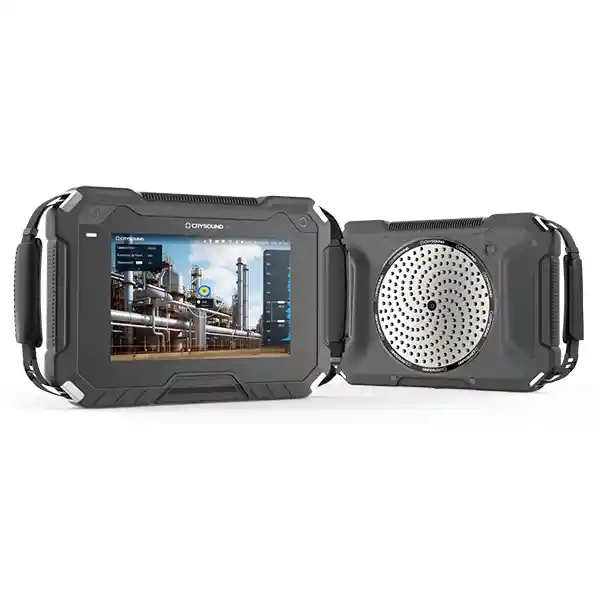
The CRYSOUND CRY8124 acoustic imaging camera brings advanced sound visualization to demanding industrial inspection and predictive maintenance programs. Its 200-channel MEMS microphone array helps operators quickly locate compressed gas leaks, electrical partial discharge and mechanical problems.
The CRY8124 combines a 2 kHz to 100 kHz frequency range with far-field acoustic localization. Therefore, operators can inspect equipment from a greater working distance. The camera supports test distances from 0.2 to 200 metres. This flexibility helps teams inspect large facilities, elevated equipment and difficult-to-access assets.
For leak detection, the CRY8124 can locate extremely small sources under specified test conditions. It can detect a 0.0029 L/min leak at 10 metres and 2.7 bar. It also estimates leak volume to help teams evaluate losses and prioritize repairs.
Electrical teams can use the CRY8124 for partial discharge detection and type recognition. The camera provides PRPD spectrum functionality to support detailed electrical inspections. In addition, maintenance teams can use acoustic imaging to investigate bearings, conveyors and other mechanical equipment.
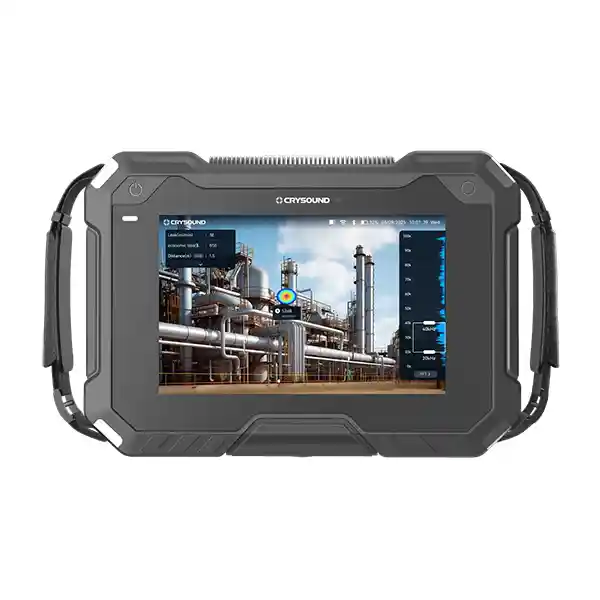
An 8-inch capacitive touchscreen provides a 1920 × 1200 display with 600-nit brightness. As a result, operators can review acoustic information clearly in bright outdoor conditions. The camera also weighs only 1.4 kg, which supports comfortable single-handed inspections.
CRYSOUND reporting software extends the inspection workflow beyond the field. Users can analyze results, edit inspection information and generate reports for maintenance documentation and critical data sharing.
Westech Industrial supplies the CRYSOUND CRY8124 with application-focused support for Canadian industrial customers. Our technical team can assist with product selection, troubleshooting and broader inspection requirements. When projects extend beyond individual instruments, Westech also provides engineering, custom fabrication and integrated industrial solutions for application-specific requirements.
Quantity
PRODUCT FEATURES
REQUEST FOR INFORMATION
Description
Product Features
200-Microphone Array for Precise Acoustic Localization
The CRY8124 uses a 200-channel MEMS microphone array to capture and visualize acoustic energy across industrial environments. The large microphone array improves the camera’s ability to separate and locate sound sources. This capability proves especially useful when operators inspect complex facilities with multiple machines operating nearby.
The system covers frequencies from 2 kHz to 100 kHz. Therefore, it can capture both audible and ultrasonic information for several inspection tasks. Operators can use one platform for compressed gas leak detection, partial discharge inspections and mechanical condition assessments.
Detect Small Compressed Gas Leaks from Greater Distances
The CRY8124 helps maintenance teams locate leaks in compressed, non-volatile gas systems without manually inspecting every fitting or connection. Its acoustic image identifies the source and overlays its location on the camera display.
Under specified conditions, the camera can detect a leak of 0.0029 L/min from 10 metres at 2.7 bar. At 0.5 metres and 1.9 bar, it can detect a 0.0028 L/min leak.
The CRY8124 also provides leak volume estimation. Consequently, teams can move beyond locating a problem and begin evaluating its significance. This information can help maintenance personnel prioritize repairs and identify opportunities to reduce compressed gas losses.
Advanced Partial Discharge Detection and Recognition
Electrical partial discharge can provide an early indication of insulation or equipment problems. The CRY8124 helps operators locate partial discharge sources and assess electrical assets without relying on sound alone.
The system supports partial discharge localization, PRPD spectrum analysis and discharge type recognition. Its frequency range extends to 100 kHz, giving electrical maintenance teams access to ultrasonic information during inspections.
Operators can use the camera when inspecting switchgear, insulators and other electrical equipment. The visual acoustic display also helps teams document the location of detected activity for further investigation.
Far-Field Sound Visualization for Faster Inspections
The CRY8124 supports real-time far-field sound source localization and visualization across test distances from 0.2 to 200 metres. This wide operating range gives inspection teams flexibility when equipment sits overhead, behind barriers or across large process areas.
Directional focus and multi-point imaging help operators concentrate on relevant acoustic sources. Meanwhile, distance measurement provides additional inspection context.
The camera’s 13-megapixel optical camera and 66-degree field of view provide a clear view of surrounding equipment. Operators can also use up to 6X digital zoom when they need a closer visual reference.
Clear 8-Inch Touchscreen for Field Inspection
The CRY8124 features an 8-inch capacitive touchscreen with 1920 × 1200 resolution. The large display gives operators room to review acoustic images and inspection information directly in the field.
A screen brightness of 600 nits helps maintain visibility in bright conditions. The camera supports both automatic and manual brightness adjustment. Four LED lights also help illuminate equipment when ambient lighting is limited.
Together, these features allow operators to identify and document problems without repeatedly returning to a computer during an inspection route.
Lightweight Design and Extended Battery Operation
Industrial walkdowns can cover large areas, so camera weight and battery life can directly affect productivity. The CRY8124 weighs just 1.4 kg (3 lbs) and features a rubber-moulded grip for secure, single-handed operation.
Each replaceable smart battery provides up to five hours of operation. The standard configuration includes two batteries, providing up to 10 hours of combined operating time.
Battery indicators help operators monitor available charge during inspections. Therefore, teams can plan longer inspection routes while reducing interruptions for charging.
Flexible Connectivity and Data Transfer
The CRY8124 supports several methods for transferring inspection information. Wi-Fi and Bluetooth provide wireless connectivity, while USB-C and microSD offer additional data transfer options.
Bluetooth 5.2 allows compatible wireless connections, including supported headphones. Wi-Fi supports direct data transfer to local devices and reporting workflows.
The camera includes 64 GB of internal storage and supports 64 GB of external microSD storage. It can store pictures, video, audio and inspection data in multiple formats.
Two USB-C connections provide charging, data export and external sensor connectivity. In addition, the CRY8124 includes a 3.5 mm headphone output.
External Sensor Inputs Expand Inspection Capabilities
Four analog input channels allow operators to connect compatible external sensors. These inputs cover frequencies from 20 kHz to 100 kHz.
Compatible sensor options can expand the CRY8124 beyond standard handheld acoustic imaging. For example, the system can work with external microphones, accelerometers and other supported sensors for more complex inspection scenarios.
A contact ultrasound sensor can also support internal leak detection in pipelines and valves.
Optional Thermal Imaging for Additional Inspection Insight
CRYSOUND offers optional thermal imaging camera modules for the CRY8124 platform. Available resolutions include 384 × 288 and 640 × 512.
Thermal imaging adds another layer of information when temperature helps operators understand equipment condition. When configured with thermal capability, teams can compare thermal and acoustic information during the same inspection workflow.
This combination can prove valuable when inspecting equipment where both abnormal sound and temperature provide useful diagnostic information.
Reporting Tools Turn Inspection Data into Actionable Information
The CRY8124 includes software functions designed to support complete inspection workflows. Operators can use multi-point imaging, directional focus, distance measurement and leak volume estimation directly within the system.
Additional functions include PRPD spectrum analysis, partial discharge type recognition, picture labelling and report export.
CRYSOUND reporting software also supports offline analysis and editing. Therefore, teams can review inspection findings after returning from the field. They can then create reports for maintenance planning, asset records and communication between departments.
Applications
Compressed Air and Gas Leak Detection
Locate leaks in compressed, non-volatile gas systems, pneumatic equipment, pipelines, fittings and industrial facilities. Leak volume estimation can also help maintenance teams prioritize repairs.
Electrical Partial Discharge Detection
Locate and evaluate partial discharge activity in switchgear, insulators and other electrical equipment. PRPD spectrum analysis and type recognition provide additional diagnostic information.
Predictive Mechanical Maintenance
Identify abnormal acoustic behaviour in bearings, conveyors and other mechanical equipment. Maintenance teams can use these findings to support condition-based maintenance programs.
Industrial Noise Source Identification
Locate individual sound sources within busy industrial environments. Acoustic visualization helps teams investigate equipment noise and identify areas that require further assessment.
HVAC System Diagnostics
Investigate abnormal sounds from ventilation, heating and air-conditioning equipment. The camera can help locate duct leaks, fan noise, compressor issues and other acoustic sources.
Automotive NVH Testing
Use acoustic localization to investigate noise, vibration and harshness concerns. Applications can include rattles, squeaks, wind noise and other unwanted vehicle sounds.
Pipeline and Valve Inspection
Use acoustic imaging for external leak surveys or add a compatible contact ultrasound sensor for internal leak detection in pipelines and valves.
Thermal and Acoustic Inspection
Add an optional CRYSOUND thermal imaging module when inspection teams need both temperature and acoustic information for equipment assessment.

Manufacturer info
CRYSOUND develops advanced acoustic imaging and measurement technologies that help industrial teams detect gas leaks, identify partial discharge, and troubleshoot equipment more efficiently. Its portable acoustic cameras combine high-sensitivity detection, intuitive imaging, and reporting tools for safer, more effective industrial inspections.