UE Vanguard WirelessHART® Fixed Point Gas Detector
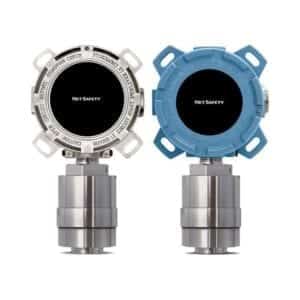
The UE Vanguard WirelessHART® Fixed Point Gas Detector monitors combustible and toxic gases without traditional power and signal wiring. Therefore, facilities can expand gas detection coverage while reducing engineering, installation and deployment requirements.
The detector communicates through WirelessHART HART 7.9 with SafeHART. It can join existing WirelessHART networks and predictive asset maintenance systems. This connectivity makes Vanguard suitable for remote, temporary and difficult-to-wire locations.
The Vanguard wireless gas detector supports methane, propane, hydrogen sulphide, carbon monoxide and ammonia sensors. UE’s FLEXSense™ technology lets technicians interchange sensor packs without replacing the complete transmitter. The sensor packs include an integrated sensor and stainless steel protective housing.
A five-year battery helps reduce routine maintenance requirements. Meanwhile, a single external button provides convenient access for calibration and bump testing. The graphical LCD also displays gas readings, device information and maintenance prompts.
UE offers two transmitter models for different hazardous-area classifications. The TCD50 covers Groups C and D or IIB locations. The TCD60 expands coverage to Groups A, B, C and D or IIC locations. It also provides interchangeable antenna choices for demanding wireless installations.
The UE Vanguard WirelessHART® Fixed Point Gas Detector is available Canada Wide at Westech Industrial. Westech Industrial can help select the appropriate model, sensor, antenna and mounting arrangement. Our service capabilities can also support calibration, maintenance and replacement planning. In addition, Westech provides custom fabrication for mounting structures, instrument panels, shelters and packaged detection systems.


Quantity
PRODUCT FEATURES
REQUEST FOR INFORMATION
Description
Wireless Gas Monitoring Without Extensive Wiring
The Vanguard wireless gas detector provides fixed-point monitoring where power or signal wiring presents practical challenges. Its battery-powered design can reduce trenching, conduit, cable and electrical installation requirements.
The detector uses WirelessHART® HART 7.9 with SafeHART communication. Its wireless design supports remote, temporary and difficult-to-wire location
Five-Year Battery for Reduced Maintenance
The five-year battery supports long-term operation without a permanent external power supply. This design helps reduce maintenance visits and supports installations in isolated locations.
The battery pack operates at a nominal 7.2 volts and contains two non-rechargeable cells (6.0-8.0 V). Users must order the battery separately from the detector configuration.
Battery voltage also serves as a WirelessHART process variable. Therefore, operators can track battery condition through the connected network and plan replacement activities.
FLEXSense™ Interchangeable Gas Sensors
UE’s patented FLEXSense™ design supports interchangeable combustible and toxic gas sensor packs. Technicians can hot-swap the sensor rather than replace the complete transmitter.
This approach can simplify spare-parts inventory and reduce technician training requirements. It also lets facilities standardize the transmitter platform across several gas detection applications.
Available sensors cover methane, propane, hydrogen sulphide, carbon monoxide and ammonia. Methane and propane use non-dispersive infrared technology. The toxic gas configurations use electrochemical sensors.
Combustible and Toxic Gas Detection
The Vanguard monitors methane and propane from zero to 100% LEL. Both sensor types provide 1% LEL resolution.
The hydrogen sulphide sensor covers zero to 100 ppm. The carbon monoxide sensor covers zero to 2,000 ppm. Meanwhile, the ammonia sensor covers zero to 100 ppm.
The transmitter communicates gas concentration as its primary process variable. Toxic gas values appear in ppm. Hydrocarbon values appear as a percentage of the lower explosive limit.
TCD50 and TCD60 Model Options
The TCD50 supports Class I, Division 1, Groups C and D applications. It also supports IIB Zone 1 classifications. This model includes a 2.0 dBi antenna.
The TCD60 supports Class I, Division 1, Groups A, B, C and D. It also carries IIC Zone 1 classifications.
Additionally, the TCD60 accepts field-replaceable 2.0, 4.35 or 6.0 dBi antennas. A remote antenna kit and 20-foot antenna extension support installations with challenging signal conditions.
Flexible Mounting and Remote Accessories
FLEXmount™ options help adapt the Vanguard wireless gas detector to different installation requirements. Available configurations include standard, magnetic and universal mounts.
The standard option fits a two-inch pipe. The magnetic mount supports suitable metal surfaces. Meanwhile, the universal mount accommodates cylindrical structures and other installation arrangements.
UE also offers remote antenna and remote sensor kits. These accessories let installers position key components for better signal strength or gas exposure.
Simple Calibration and Local Display
A single external button gives technicians access to bump testing and calibration functions. This design reduces the need to open the enclosure during regular maintenance.
The graphical LCD measures 2.25 inches wide by 1.25 inches high. It provides local access to readings, prompts and device information in English.
WirelessHART variables can also report temperature, days since calibration and battery voltage. Temperature reporting does not apply to hydrocarbon sensor configurations.
Rugged Construction for Hazardous Locations
The transmitter combines an aluminum alloy enclosure with powder polyester paint and 316 stainless steel components. It also uses nickel-plated brass and tempered glass.
The enclosure carries Type 4X and IP66 ratings. However, these enclosure ratings exclude the gas sensor. They also do not guarantee gas detection during or after environmental exposure.
The transmitter supports temperatures from -40°C to 65°C (-40°F t0 149°F). However, the selected sensor determines the final operating range.
Certified Combustible Gas Performance
IEC-certified methane and propane sensors are available for applications from −20°C to 60°C (-4°F to 140°F). Separate extended-temperature configurations operate from −40°C to 65°C (-40°F to 149°F) but do not carry IEC 60079-29-1 certification.
The toxic gas sensors also do not carry IEC 60079-29-1 certification.
Applications
The Vanguard wireless gas detector supports fixed-point monitoring where traditional power and signal wiring may be difficult or costly. Its wireless design suits permanent, temporary and remote gas detection applications across industrial sites.
- Storage tank farms and tank overfill monitoring
- Fence-line and emissions monitoring
- Remote enclosed locations
- Temporary or remote well plugging and abandonment sites
- Management-of-change deployments
- Hazardous locations without permanent infrastructure
- Areas with limited power and signal wiring
- Signal-challenged locations requiring remote antenna placement
Documents

Manufacturer Info
United Electric Controls (UE) is a privately-held corporation founded in 1931 and headquartered in Watertown, Massachusetts, USA. Focused on protecting equipment, processes, personnel and the environment, UE is a global supplier of toxic and combustible WirelessHART gas detectors, electronic transmitter-switches, pressure and temperature switches, transmitters, sensors and controls for the process, discrete, semiconductor, aerospace and defense industries.
Website: http://www.ueonline.com