Jacoby-Tarbox Program AccuBlend CFD (Computational Fluid Dynamics) (Clark Reliance)
The Jacoby-Tarbox® AccuBlend CFD program uses Computational Fluid Dynamics to develop engineered tank mixing solutions. The program models fluid movement within a tank or reservoir before equipment selection.
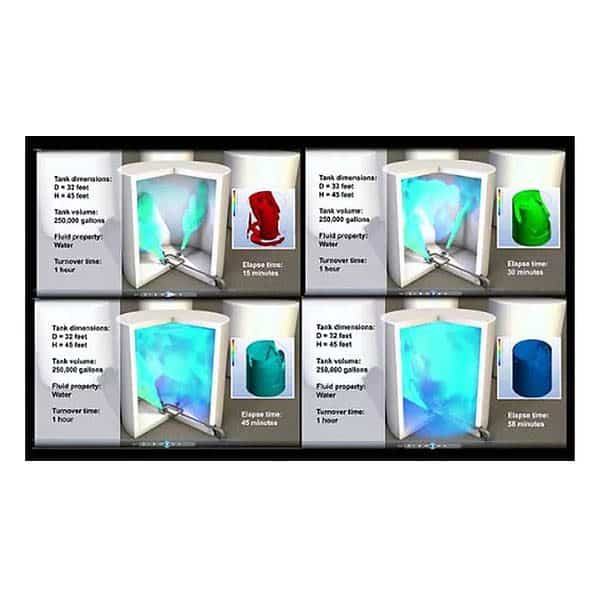
Engineers use the AccuBlend CFD analysis to evaluate each stage of the mixing process. The simulation displays flow patterns, directional velocities and velocity profiles throughout the tank. It can also show fluid movement over time through a digital video simulation.
Jacoby-Tarbox uses the results to determine the required number of Tank Liquid Agitators™ (TLAs). The analysis considers the tank dimensions, fluid properties, mixing objective and required turnover time.
Jacoby-Tarbox eductors create a pressure differential that produces suction, mixing and liquid circulation. They require no direct power and contain no moving parts. Therefore, they provide a practical alternative to mechanical mixing equipment for suitable applications. Learn more about Jacoby-Tarbox Eductors and Tank Liquid Agitators.
Westech Industrial provides Jacoby-Tarbox AccuBlend CFD analysis and eductor solutions across Canada. Our team can help gather application details, coordinate the analysis and review the proposed equipment. Westech can also assess service and custom fabrication requirements within the broader process system.
Product Videos
Watch the short video below on the AccuBlend CFD (Computational Fluid Dynamics).
Quantity
PRODUCT FEATURES
REQUEST FOR INFORMATION
Description
Computational Data for Engineered Mixing
AccuBlend CFD analysis uses actual computational data to model fluid behaviour inside a tank or reservoir. Unlike equipment selection based only on general assumptions, the program considers the customer’s specific operating conditions.
Jacoby-Tarbox engineers create a model using the tank dimensions, fluid properties and desired turnover time. They also consider the primary mixing goal. These goals may include blending, suspending solids, combining stratified layers or supporting heating applications.
As a result, customers can review how the proposed mixing arrangement should perform before selecting the eductors.
Visual Mixing and Velocity Analysis
The AccuBlend CFD program displays the stages of mixing from initial startup through complete tank turnover. It maps the flow direction and velocity magnitude throughout the tank.
The simulation uses different colours to represent fluid velocity. Dark blue identifies areas with little or no movement. Red identifies areas with the highest movement. Other colours show the velocity ranges between these points.
These visual results help identify areas where fluid movement may remain limited. They also show how the mixing pattern develops over time.
TLA Quantity and Mixing Arrangement
Jacoby-Tarbox uses the CFD results to determine the number of Tank Liquid Agitators required for the application. The analysis also shows how each TLA contributes to the overall fluid movement.
Customers can review velocity profiles, directional flow and fluid velocity within the tank. In addition, a digital video simulation shows the tank mixing over time.
This process connects equipment selection directly to the required mixing objective and turnover time.
CFD-Validated Eductor Design
Jacoby-Tarbox combines AccuBlend CFD analysis with eductors designed for efficient fluid movement. A smooth specified finish supports the intended flow paths through the eductor.
The mixing tube section withstands pipe stress within the process installation. Wrench flats also help protect the eductor from installation damage.
Jacoby-Tarbox in-line eductors feature a CFD-validated design and full ASME rating. The company also supports applications through its engineering services.
Example CFD Tank Analysis
One wastewater analysis evaluated an atmospheric tank measuring 32 feet high and 35 feet in diameter. The application required a 55-minute turnover time.
The model developed a solution using fourteen 2-inch TLAs in 316 stainless steel. The simulation calculated complete tank turnover within 48 minutes. It also calculated an average fluid velocity of 0.45 feet per second.
This example demonstrates how AccuBlend CFD analysis connects application data with an engineered TLA arrangement.
Applications
AccuBlend CFD analysis supports tank and process-line applications that require predictable fluid movement. The program helps evaluate the mixing objective before Jacoby-Tarbox selects the required eductor arrangement.
- Tank mixing and blending
- Wastewater treatment
- Suspending solids
- Mixing stratified liquid layers
- Tank heating applications
- Liquid circulation within tanks and reservoirs
- Chemical process mixing
- In-line mixing, pumping and heating
- Applications replacing mechanical mixing equipment

Manufacturer Info
Clark-Reliance® Corporation is a global leader in the level indication and control, sightflow indication, filtration and separation industries. The company’s well-known brands constitute the broadest line of level instrumentation for boilers and other equipment found in utilities, refineries, chemical processing and other industries.
Website: https://www.clarkreliance.com/