Jacoby-Tarbox Bulls-Eye Sight Flow Indicators – Threaded (Clark Reliance)
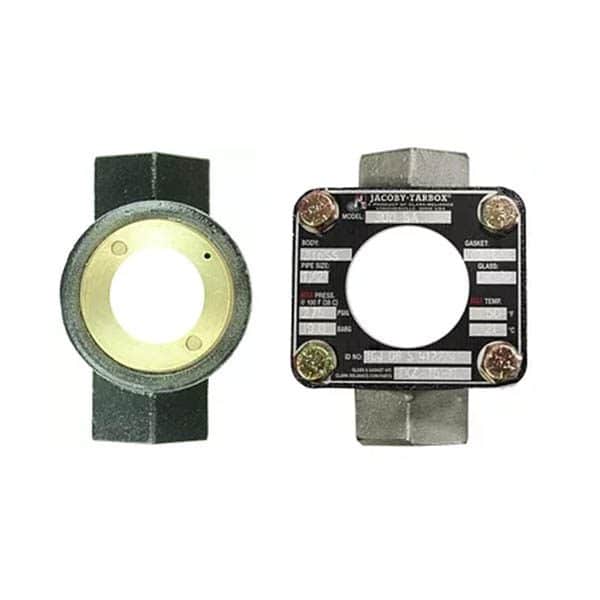
Jacoby-Tarbox threaded bulls-eye sight flow indicators provide a clear, full-view window into non-flanged process piping. Operators can observe fluid presence, colour, clarity, air entrainment, interface, and changing flow conditions.
The product line covers nominal 150 psig systems and full ASME-rated applications. Available pressure classes include ASME Class 150, 300, 600, 900, and 1500. Therefore, users can select a configuration for medium-pressure or demanding high-pressure service.
Jacoby-Tarbox designs its full ASME-rated models using the criteria of ASME B31.1 and B31.3 piping codes. The manufacturer also uses listed ASTM metals throughout each unit’s construction. Available configurations support liquids, slurries, gases, solids, condensate, and partially filled lines.
Westech Industrial supplies Jacoby-Tarbox threaded sight flow indicators Canada-wide. Our team can help match the body, pressure class, window, gasket, indicator, and connection to your process.
Westech also provides technical service and product support throughout the equipment lifecycle. Additionally, our Custom Fabrication team can integrate sight flow indicators into fabricated process assemblies and packaged systems.

Quantity
PRODUCT FEATURES
REQUEST FOR INFORMATION
Description
Full-View Process Observation
The Threaded Sight Flow Indicators’ bulls-eye design maximizes the visible process area. In most configurations, the viewing diameter matches or exceeds the pipe’s inside diameter.
This design provides an unobstructed view of liquids, gases, slurries, and solids. As a result, operators can quickly verify process presence and changing conditions.
The window can also reveal colour, clarity, air entrainment, and liquid interfaces. These visual checks can support troubleshooting and routine process monitoring.
Threaded Sight Flow Indicators for Multiple Pressure Classes
Jacoby-Tarbox offers two medium-pressure families. ST models provide a nominal rating up to 150 psig. SA models provide full ASME Class 150 performance.
The high-pressure line includes ASME Class 300, 600, 900, and 1500 configurations. Maximum listed pressures reach 750, 1,500, 2,250, and 3,750 psig respectively.
However, body material and operating temperature affect the final pressure rating. The lowest-rated selected component also sets the unit’s temperature limit.
This broad range helps facilities standardize visual flow indication across several piping pressure classes.
Indicator Configurations for Different Flow Conditions
Several internal indicator configurations help users interpret different process conditions.
Plain models provide an open view for confirming the presence or absence of process media. They support bidirectional flow and horizontal or vertical installation.
Weighted flappers change position as flow changes. This movement provides a simple visual indication in unidirectional applications.
Rotors indicate relative process velocity through their rotation speed. Standard configurations use a PTFE rotor with a 316 stainless steel pin.
Drip tube models support condensing gases and partially full liquid lines. Gas indicators suit gas flow and low-velocity liquid flow in full lines.
Selected 100 models can also use a PTFE flutter configuration.
Minimal Pressure Drop in Non-Rotor Models
Non-rotor models use smooth, unrestricted internal openings. These openings measure no smaller than the pipe’s inside diameter.
Consequently, the design minimizes flow restriction and pressure loss. It also preserves a clear process view through the body.
The rotor configuration contains an internal moving element. Therefore, the unrestricted-flow description applies specifically to non-rotor models.
Window and Shield Options
Standard ST models use annealed borosilicate glass. SA and high-pressure models use tempered borosilicate glass as their standard window material.
Each standard unit includes one window on each side, for two windows total. Select SA and high-pressure models can use an FM-approved dual-window configuration. This option places two windows on each side, for four total.
UniShield® Window Protection adds bonded PFA shielding for chemical resistance. UniGlas® provides a fused safety-window option. Quartz glass can support higher-temperature applications when the other selected components also permit that temperature.
Available window and shield choices vary by product family and construction.
Material and Connection Flexibility
Available cast-body materials include carbon steel, 316 stainless steel, bronze, 316L stainless steel, Hastelloy® C, Alloy 20, and Monel®. Duplex stainless steel can also support selected requirements.
Standard body machining provides NPT connections. Optional butt-weld and socket-weld ends accommodate other non-flanged piping systems.
Available gasket materials include neoprene, Gylon® 3545, fibre, graphite, and FKM. However, gasket availability changes for Class 900 and Class 1500 models. Neoprene and FKM are not available for Class 900 and Class 1500 models.
Compliance, Testing, and Identification
Jacoby-Tarbox designs the full ASME-rated models to ASME B31.1 and B31.3 criteria. The line also carries Canadian Registration Numbers for all provinces.
Additional listed compliance includes API 614 and NACE MR0175/ISO 15156-1 MRO103 for wetted metals. PED tagging requires specification when ordering.
Each unit receives a 100% hydrotest. Stainless steel engraved identification faceplates provide clear equipment information in the field.
Applications
Jacoby-Tarbox threaded sight flow indicators support process observation across medium-pressure and high-pressure piping systems. Their material, indicator, and window choices suit many industrial services.
Common applications include:
- Refining and petrochemical processes
- Chemical processing systems
- Power generation facilities
- Pharmaceutical manufacturing
- Drain and return lines
- Lubrication and hydraulic systems
- Condensate and partially filled liquid lines
- Food process lines
- Gas and low-velocity liquid flow
- Original equipment manufacturer packages
- Process systems handling liquids, gases, slurries, or solids
Documents

Manufacturer Info
Clark-Reliance® Corporation is a global leader in the level indication and control, sightflow indication, filtration and separation industries. The company’s well-known brands constitute the broadest line of level instrumentation for boilers and other equipment found in utilities, refineries, chemical processing and other industries.
Website: https://www.clarkreliance.com/