PFS Classical Venturi (CV)
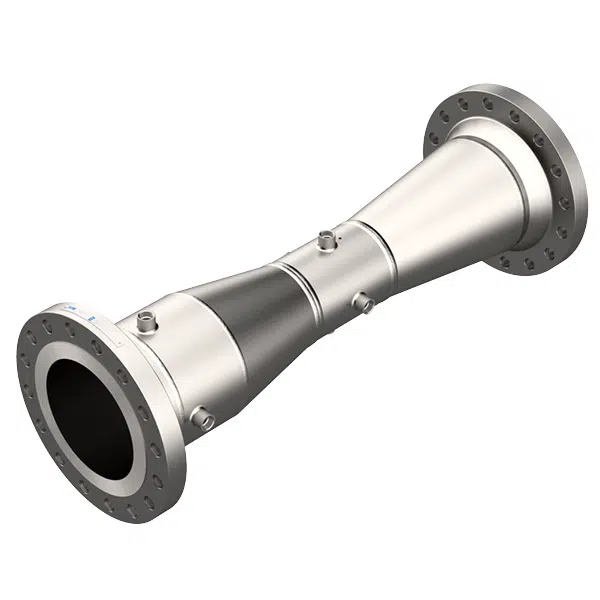
The PFS Classical Venturi flow meter provides accurate flow measurement with low permanent pressure loss. It measures clean liquids, gases and steam across municipal and industrial applications.
The meter creates a controlled restriction within its throat. This restriction increases fluid velocity and produces a measurable pressure difference. Secondary instrumentation then uses this differential pressure to determine the flow rate.
PFS can design the throat around the operating conditions of each application. This approach helps balance measurement accuracy with permanent pressure loss. Furthermore, the streamlined design reduces pressure loss compared with orifice and nozzle-style meters.
With no moving parts, the Classical Venturi supports extended service life and reliable operation. Its design also offers lower susceptibility to erosion. As a result, it suits high-pressure, high-temperature and high-velocity flow applications.
The CV Series includes flanged, butt-weld, eccentric and insert configurations. A broad selection of construction materials also supports different process conditions.
Westech Industrial supplies the PFS Classical Venturi flow meter across Canada. Our team can help review application requirements, meter configuration and material selection. Westech also provides service capabilities and custom fabrication support for complete flow measurement installations.
Quantity
PRODUCT FEATURES
REQUEST FOR INFORMATION
Description
Low Permanent Pressure Loss
The Classical Venturi flow meter uses a gradual inlet, restricted throat and expanding outlet section. This streamlined geometry recovers more pressure than many other differential pressure meter designs.
Head loss typically ranges from 10% to 25% of the measured differential pressure. Therefore, the meter can reduce ongoing energy losses within the piping system. Lower pressure loss may also support more efficient process operation.
Application-Specific Throat Design
PFS can size the meter throat for the required flow measurement conditions. The selected design helps optimize accuracy, differential pressure and permanent pressure loss.
The available beta ratio ranges from 0.30 to 0.75. This range gives designers flexibility when matching the meter to pipe size, flow rate and operating requirements.
Reliable Differential Pressure Measurement
The meter measures pressure before and at the restricted throat. The resulting pressure difference corresponds to the fluid’s flow rate.
Calibrated meters provide a basic accuracy of ±0.25% of total flow. Uncalibrated accuracy ranges from ±0.75% to ±1.50%. In addition, the meter provides repeatability of ±0.1%.
Accuracy and repeatability describe different performance characteristics. Accuracy indicates how closely the measurement matches the actual flow. Repeatability describes the meter’s ability to reproduce the same result under consistent conditions.
Broad Turndown Capability
The Classical Venturi flow meter can support turndown ratios of 10:1, 20:1, 50:1 or greater. Actual turndown depends on the meter design and the selected secondary instrumentation.
This flexibility allows one meter to measure changing flow conditions across a wide operating range. However, the complete measurement system must support the required turndown.
No Moving Parts
The CV Series contains no moving measurement components. Consequently, it avoids wear associated with rotating or mechanically actuated flow meters.
The design supports medium-to-long service life and carries a 25-year warranty. Its internal profile also reduces susceptibility to erosion. These characteristics can lower maintenance requirements and operating costs over time.
High-Pressure and High-Temperature Capability
Classical Venturi meters suit demanding steam and liquid flow applications. They also perform well in high-pressure, high-temperature and high-velocity processes.
Available construction materials include carbon steel, stainless steel and chrome moly. Other options include aluminum, Monel, tantalum, zirconium, duplex stainless steel, 321 stainless steel, Hastelloy and titanium.
Flexible Installation and Connection Options
The meter can mount in any position when the installation meets application requirements. The CV Series includes eccentric (CVE), flanged (CVF), butt-weld (CVW) and insert (CVI) configurations.
Straight-pipe requirements depend on the specific application. Therefore, PFS reviews the upstream and downstream piping arrangement when determining installation requirements.
Recognized Design Standards
PFS designs the Classical Venturi according to ASME MFC-3M, ISO 5167-4 and PTC 19.5 standards. Additionally, NSF-61-approved coatings are available upon request for potable water applications.
Applications
The PFS Classical Venturi flow meter suits processes that require dependable differential pressure measurement with low pressure loss. It can measure clean liquids, gases and steam. Industrial installations may also handle dirty fluids when the meter uses remote seals.
- Steam and water flow measurement
- Hydrocarbon liquid and gas processes
- Water treatment and distribution
- Oil production and refining
- Chemical and petrochemical processing
- High-velocity process flow
- High-pressure steam systems
- High-temperature liquid flow
- Potable water systems with optional NSF-61-approved coatings

Manufacturer info
Primary Flow Signal designs and manufactures flow measurement solutions for liquid, gas, and steam applications. Its product offering includes Venturi flow meters, wedge-type meters, orifice flow elements, flow nozzles, and custom-engineered differential pressure measurement products for industries such as water and wastewater, oil and gas, power generation, industrial processing, automotive, and cryogenic service.