
Boiler Drum Level Instrumentation & Code
Upgrading boiler drum level instrumentation can improve visibility, remote monitoring and control system integration. However, new transmitters and magnetic level indicators do not automatically replace the direct-reading gage glass required for applicable boilers under ASME Section I.
For Canadian energy facilities planning an upgrade, the starting point is a review of the complete installation: what each instrument measures, which functions it performs and how the proposed changes will preserve required level indication.
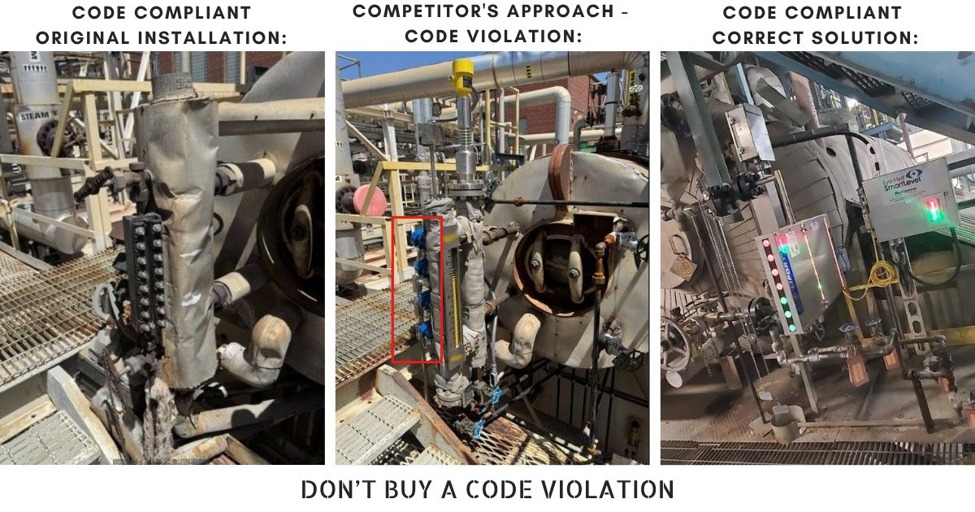
An example shared by Westech Industrial’s partner, Clark-Reliance, illustrates why this matters. A traditional gage glass and conductivity probe water column were replaced with guided wave radar and a magnetic level indicator. Although the new equipment provided level information, removing the gage glass overlooked an important code requirement.
Why Direct and Indirect Boiler Level Indication Are Different
A direct-reading gage glass allows an operator to observe the actual water level through a transparent viewing surface. A magnetic level indicator uses a float inside a chamber to operate an external visual display.
Both provide visible information, but their measurement principles—and their treatment under the code—are different.
A magnetic level indicator is an indirect level device. It does not, by itself, satisfy the requirement for a direct-reading gage glass. Electronic transmitters also provide indirect measurement, even when their readings are displayed locally beside the boiler.
This distinction should be established before removing existing equipment or approving a replacement arrangement.
What Are the ASME Gage Glass Requirements?
ASME Boiler and Pressure Vessel Code, Section I, includes water level indication requirements for applicable power boilers. Boilers with a fixed steam-water interface generally require at least one gage glass, subject to the code’s stated exceptions.
For boilers with a maximum allowable working pressure (MAWP) of 400 psig or less, at least one gage glass must remain in service.
Higher-pressure boilers have additional indication requirements. Under specified conditions, qualifying independent remote level indicators can permit the required gage glass to be isolated, but the glass must remain installed and serviceable.
MAWP is the boiler’s rated maximum allowable working pressure. It should not be confused with the pressure at which the boiler normally operates.
For a Canadian installation, confirm the applicable code edition, provincial or territorial requirements, and any review or acceptance needed from the authority having jurisdiction. A manufacturer’s general guidance supports this review but does not replace an assessment of the specific installation.
How Operating Conditions Affect Magnetic Level Indicators
Magnetic level indicators rely on a float selected for the fluid’s density, or specific gravity. Boiler water density changes as temperature and pressure change, which can affect the indicated level.
An instrument selected for normal operating conditions may therefore develop a reading offset during startup, shutdown or operation at a different pressure.
When evaluating a magnetic level indicator for boiler service, ask:
- What fluid density and operating conditions were used to select the float?
- How will the indication change across the expected pressure and temperature range?
- How will operators verify a disagreement between instruments?
- What inspection and maintenance procedures does the manufacturer require?
These questions help distinguish display readability from measurement accuracy across the operating range.
Review Switches, Transmitters and Control Functions
The review should include accessories attached to a magnetic level indicator, as well as the indicator itself.
Clark-Reliance cautions that external switches or transmitters attached to a magnetic level gage for control functions are prohibited under the applicable code requirements governing these devices. Equipment arrangements used elsewhere in a facility should not automatically be carried over to boiler drum service.
Identify whether each signal is used for indication, alarm, control or protective action. Have the proposed arrangement reviewed against the applicable requirements before ordering or installing equipment.
Give Each Boiler Level Instrument a Defined Role
Different technologies can complement one another when their functions are clearly defined. Clark-Reliance describes an approach combining direct visual indication, conductivity-based remote indication and continuous electronic measurement.
Direct-Reading Gage Glass
A suitable gage glass provides direct visual confirmation of water level. Reliance Simpliport ported gages are one example of this technology. Selection must account for pressure, temperature, viewing requirements and installation details.
Conductivity Probe Level Indication
Conductivity probe systems, such as Eye-Hye SmartLevel, detect water at defined probe elevations and can support remote indication and applicable alarm functions.
Guided Wave Radar
Guided wave radar can provide continuous level measurement for control and additional indication. Its suitability depends on the application, installation and manufacturer’s requirements.
Combining these technologies does not automatically establish compliance. The complete arrangement must meet the requirements for the particular boiler, including any required independence between systems.
Boiler Instrumentation Upgrade Checklist
Before approving a modification, document answers to these questions:
- What requirements apply? Confirm the boiler type, MAWP, applicable code edition and jurisdictional requirements.
- Which existing functions must be preserved? Record the purpose of each indicator, alarm, control signal and protective function.
- Will the required gage glass remain available? Establish its required operating status and maintenance provisions.
- Are remote systems sufficiently independent? Two displays connected to one measurement source do not necessarily provide two independent systems.
- What happens under changing or failed conditions? Review startup, shutdown, pressure changes, power loss and disagreement between readings.
- Can the equipment be inspected and maintained? Consider isolation, drainage, cleaning access and manufacturer-recommended procedures.
Technical Support for Boiler Level Instrumentation
A successful upgrade improves the information available to operators while preserving the required safeguards. Reviewing the complete system before purchasing equipment can help avoid installation changes, inspection findings and unnecessary rework.
Westech Industrial can help customers gather application information, review existing instrumentation and work with Clark-Reliance to evaluate suitable options. Our team can also support the technical discussion with the engineer and boiler inspector responsible for the installation.
Planning a boiler level instrumentation upgrade? Contact Westech Industrial to discuss your current arrangement, operating conditions and project requirements.
Frequently Asked Questions
Can a magnetic level indicator replace a boiler gage glass?
A magnetic level indicator does not, on its own, replace the direct-reading gage glass required for applicable ASME Section I boilers. It is classified as an indirect level device.
Does the 400 psig threshold refer to operating pressure?
The threshold refers to maximum allowable working pressure, or MAWP, rather than the boiler’s normal operating pressure.
Can guided wave radar be used for boiler drum level measurement?
Guided wave radar can support continuous measurement in suitable boiler applications. Its use does not automatically remove the requirement for a direct-reading gage glass or other required instrumentation.
Who should review a boiler instrumentation modification?
Involve the engineer responsible for the modification and the applicable boiler inspection authority. Instrument manufacturers and Westech’s technical team can provide application information to support that review.
Technical information adapted from Clark-Reliance. Confirm installation requirements against the applicable code edition and provincial or territorial requirements.
Further reading:
Clark-Reliance: Understanding Direct and Indirect Level Indicators under ASME Section I